Understand midsummer gifts through Q&A | Frequently asked questions and thank-you letter templates
- Introduction
- Frequently asked questions about summer gifts
- Please tell me when to give gifts.
- What should I do if the person I'm giving a gift to is in mourning?
- What if you're late sending a gift?
- Do I need to give a gift in return?
- Please tell me how to write a thank you letter.
- What should I do if I want to quit midyear gift-giving?
- Finally
Introduction
With the arrival of summer comes the season of "Ochugen", a way to express gratitude to those who have helped us on a daily basis.
However, once you start preparing, many people may have a variety of questions in their mind, such as "When should I give it?" and "What is the proper etiquette?"
In particular, the format of midsummer gifts has become more diverse in recent years, with more casual gift-giving styles in addition to traditional customs.
Therefore, you may be confused as to what is correct and what is rude.
In this article, we will answer some frequently asked questions in a Q&A format to clear up any doubts you may have about summer gifts. Please use this as a reference for your summer greetings.

Frequently asked questions about summer gifts
Q1. By when should I send my midsummer gift?
A. The period for sending Ochugen is generally between July 15th and August 15th, but please note that this may vary depending on the region.
For example, in the Kanto and Tohoku regions, which are based on the Gregorian calendar, the period is two weeks from July 1st to July 15th.
In contrast, in the Kansai, Tokai, Chugoku and Shikoku regions, which are based on the old calendar, gifts should be sent within the one month period from July 15th to August 15th.
In the Hokuriku region, in Toyama Prefecture and parts of Ishikawa Prefecture on the west side, it is customary to send gifts based on the lunar calendar, but in some areas the Gregorian calendar is used, and the timing varies, so be careful. If you are not sure, it is best to send gifts on July 15th as a rough guide.

Q2. What should I do if the person I'm giving a gift to is in mourning?
A. Ochugen is a gift to express gratitude to those who have helped you on a daily basis, and is not a celebration.
Therefore, it is generally considered acceptable to exchange gifts even if either the giver or the recipient, or both, are in mourning.
However, the mourning period shortly after the death (generally within 49 days in Buddhism) is an unsettling time for the bereaved family, as they have yet to come to terms with their loss.
During this period, it is wise to refrain from exchanging gifts such as midsummer gifts and to postpone them until after the 49th day after the death and the end of mourning.

If the midsummer gift period overlaps with the 49th day memorial service, it would be more considerate and thoughtful to not force yourself to send one, but rather to send it at a different time as a "midsummer greeting" or "late summer greeting."
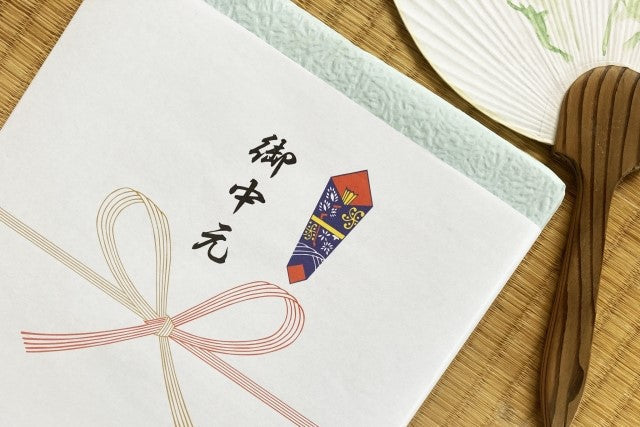
When sending midyear gifts to a family in mourning, it is considered good manners to avoid wrapping gifts with red and white mizuhiki or noshi (traditional Japanese paper string).
Instead, use plain white paper or strips of paper to avoid any celebratory connotations.
In addition, by sending a heartfelt letter or message card, you can convey your gratitude while being considerate of the mourning situation.

Q3. What if I send a midsummer gift late?
A. Generally speaking, it is considered good etiquette to send midsummer gifts within a certain period of time, but even if you are late in sending your gift, you can still politely convey your feelings by changing the inscription on the gift to suit the time of year.
In the Kanto region, the period generally ends on July 15th, but in some areas of the Chubu and Kansai regions, the period for giving gifts runs from mid-July to August 15th.

If this period has passed, send a "summer greeting" or a "summer inquiry" to a superior up until early August.
After that, if the beginning of autumn has passed and the heat of summer is still intense, you should send a "Late-summer greeting" or, if speaking to a superior, a "Late-summer inquiry."

Q4. Do I need to give something in return for the midsummer gift?
A. What should you do if you receive a midsummer gift but accidentally miss the chance to send it because you forgot to arrange it or because you didn't receive one last year and therefore weren't prepared?
Basically, midsummer gifts are sent by people with good intentions as a way of saying thank you to those who have helped you.
So, just because you receive something doesn't mean you have to give something back.
That being said, it's not really nice to just receive things and not give anything away. Whether you give a gift or not, you should always send a thank you note.

First, let us know when you receive the item and then send a thank you letter.
In your letter, you can express your gratitude for the recipient's continued support and share your thoughts about the gift they received. This will make the recipient happy and glad that they chose the gift.
When sending a gift, the general rule of thumb is to send it as soon as you are ready, but if you are sending it after the midsummer gift season, you should send it as a "midsummer greeting" or "late summer greeting" depending on the timing.
If you realize you forgot to send a gift in September, it is wise not to send one. Just send a thank you note and be sure to send a year-end gift instead of a midyear gift.
Also, be careful not to give something more expensive than the gift you received, as it would be considered rude.

Q5. How do I write a thank you letter?
A. Below, we will introduce ① the text to include in a gift to someone of higher rank , and ② the text to include in a thank-you letter to let them know that the gift has been received . Please use these as a reference.

①Example of a message to accompany a gift
"This year seems to be particularly hot. My wife and I would like to express our sincere gratitude for your continued support. We look forward to your continued support.
Today, I have sent you a small gift as a token of my appreciation for your daily support. I hope you will all enjoy it.
As the heat gets more intense day by day, we sincerely hope that you take good care of yourself.

②Example of a thank you letter to express gratitude for receiving a midsummer gift
"Dear
It's the height of summer, and we hope you are in good health and well-being, Mr./Ms. XX.
Well, thank you very much for your kind gift this time.
It's a favorite of the whole family, and we're enjoying it right away.
Please give my best regards to your wife.
Please take care of yourself and do not overexert yourself during this extremely hot weather.

Q6. What should I do if I want to stop giving midsummer gifts?
1. Recipient: When you want to refuse the gift in the future
If you receive a midsummer gift from someone you've known for many years but have since lost touch with, you may want to decline future gifts.
In such a case, you can respond smartly by following the steps below.
First of all, when you receive a gift, it is common etiquette to send a thank-you letter as usual and at the same time send a gift of similar value in return.
In this case, in your thank-you letter, you should politely state that you would like to decline future gifts, saying something like, "I am truly grateful for your continued thoughtfulness. I hope that you will not further consider my kindness in the future."
② The giver: When you don't want to give gifts in the future
Even if you want to stop giving midsummer gifts, you should avoid suddenly stopping them.
This may come across as rude to the other person or make them feel uncomfortable.
For this reason, it is considered good manners to gradually stop giving gifts, first by reducing it to only year-end gifts, and then gradually reducing the amount.
It may seem a bit troublesome, but fading out naturally over time is a consideration for maintaining smooth interpersonal relationships.

summary
What do you think? It's a Japanese tradition that is slowly fading among younger people, but they now have the time to consider the recipient's tastes and needs when choosing a gift.
I think it's wonderful to take the time to choose a gift for someone special, thinking about what would make them happy and how they have been doing lately.
Throughout its long history, Ochugen gifts have enriched Japanese culture and human relationships.
I hope this article will help you solve your problems.